Grams Beat Cups for Flour, Mostly: A Case for the Kitchen Scale
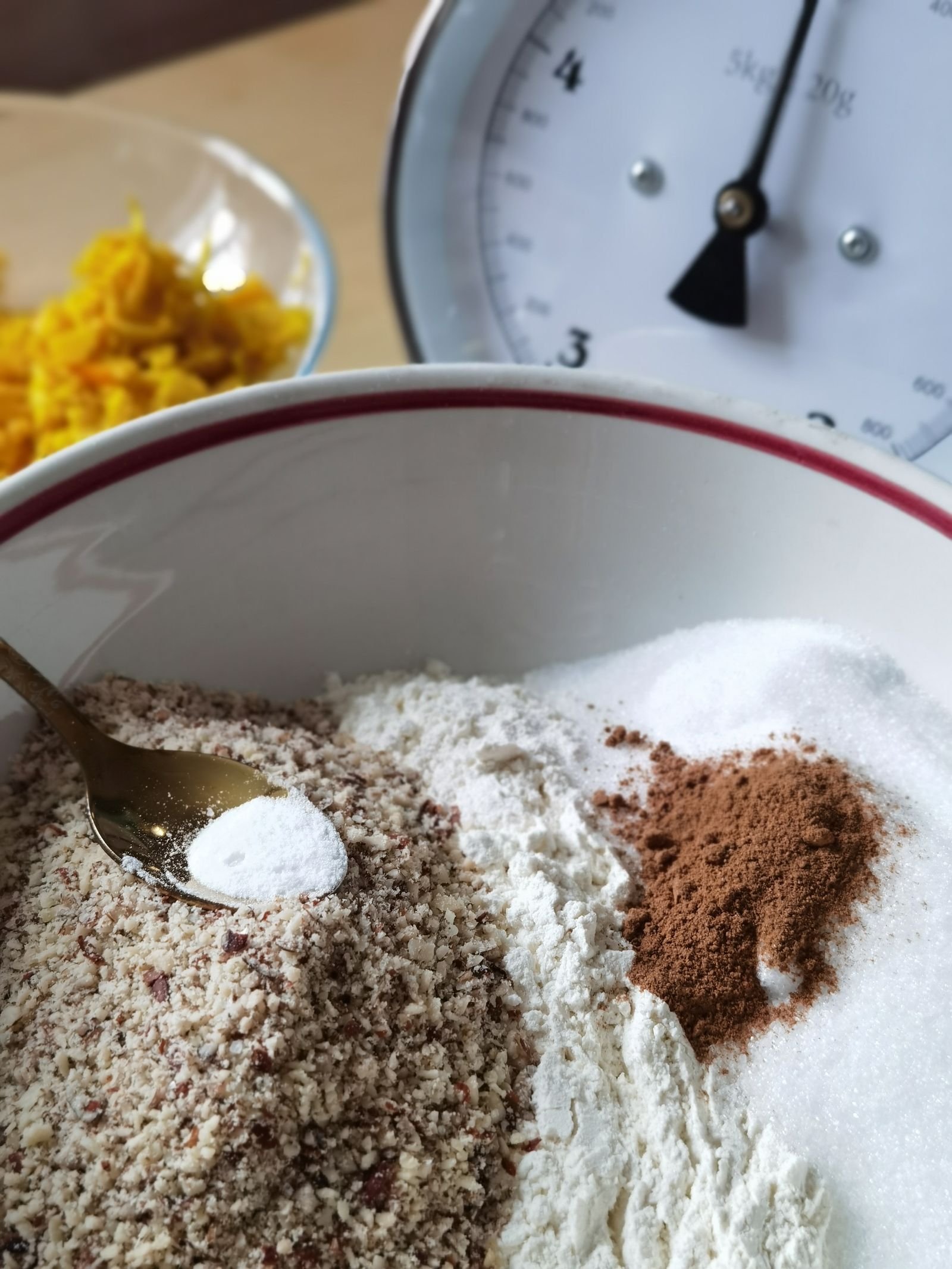
Here is a small experiment you can run before lunch. Set a kitchen scale on the counter, put a bowl on it, and press the button that zeroes it out. Measure one cup of all-purpose flour the way you normally do and tip it into the bowl. Write down the number. Empty the bowl, zero the scale, and ask someone else in the house to measure a cup their way.
When we tried this in the test kitchen, the two cups did not match. They were not wildly different, but they were different enough to matter. That gap is the whole argument for weighing flour, and it is why our baking cards list grams first.
Why a cup of flour is not a fixed amount
Flour is compressible. It settles in the bag, it fluffs up when you stir it, and it packs down when you press a measuring cup into it. A cup measures space, so how much flour fits into that space depends on how tightly it is packed.
The three common ways of filling a cup give three different results:
- Scooping straight from the bag packs the flour in and gives you the most.
- Spooning into the cup and leveling with a straight edge gives you noticeably less.
- Sifting first, then spooning gives you the least of all.
None of these methods is wrong, as long as it matches what the recipe writer used. The trouble is that many recipes do not say, and most cooks never think about it. In bread, cakes, and cookies, an extra couple of tablespoons of flour per cup can be the difference between tender and dry, or between cookies that spread nicely and cookies that sit in stiff little mounds.
What weighing actually gets you
A gram of flour is a gram of flour whether it was sifted, scooped, or sat on by the cat. When you weigh, the packing problem disappears. There are quieter benefits too:
- Fewer dishes. You can weigh everything into one bowl, zeroing the scale between ingredients. No stack of measuring cups to wash.
- Easy scaling. Halving 375 grams is simple. Halving 3 cups plus 2 tablespoons in your head is less fun.
- Repeatable results. If a loaf turns out perfectly, you can make exactly that loaf again.
- Sticky ingredients behave. Honey, peanut butter, and molasses are far easier to weigh straight into a bowl than to scrape out of a cup.
This matters to us in a very specific way. When the second cook in our two-cook testing has a slightly different scooping habit from the first, a cups-only recipe can come out differently for reasons that have nothing to do with the recipe. Grams remove that variable, so if the two bakes differ, we know to look at something real, like oven temperature or how soft the butter was.
Choosing and using a scale
You do not need anything fancy. A basic digital kitchen scale is plenty, as long as it:
- Measures in 1-gram increments.
- Has a tare or zero button.
- Holds at least 5 kilograms, so a heavy bowl plus ingredients does not max it out.
- Has a platform wide enough that a mixing bowl does not hide the display.
Keep the batteries fresh, since a weak battery can make readings drift. Set the scale on a flat, hard surface, not on a folded towel. And get in the habit of pressing tare before every single addition. The most common scale mistake we see is forgetting to zero, then adding 200 grams of sugar on top of 250 grams of flour and wondering why the math feels off.
When cups are perfectly fine
We are not scale evangelists about everything. Plenty of cooking tolerates a little variation, and cups are faster when precision does not matter much. We happily use cups for:
- Pancakes and waffles, where you can loosen a thick batter with a splash of milk.
- Soups, stews, and braises, where you taste and adjust anyway.
- Rice and grains, as long as the water is measured with the same cup.
- Dredging and breading, where flour is a coating, not a structure.
- Thickening a sauce, which you judge by eye as it simmers.
If a recipe only gives cups, follow the method it describes. If it does not describe one, stir the flour, spoon it into the cup, and level it. That is a common convention in American recipes, and it gives a lighter, less packed cup than scooping.
How our cards handle it
For baking, our cards list grams first, followed by cups and spoons for anyone without a scale. The cup amounts assume flour that has been stirred in its container, spooned into the cup, and leveled with the back of a knife. For savory cooking, we usually list cups and spoons alone, adding weights where they genuinely help, like salt for a brine or a large amount of cheese.
So run the experiment. If your two cups come out the same, you live in a remarkably consistent household. If they do not, a simple scale may be the least expensive way to make your baking more predictable, one gram at a time.