Ten Minutes of Knife Practice That Pay You Back All Year
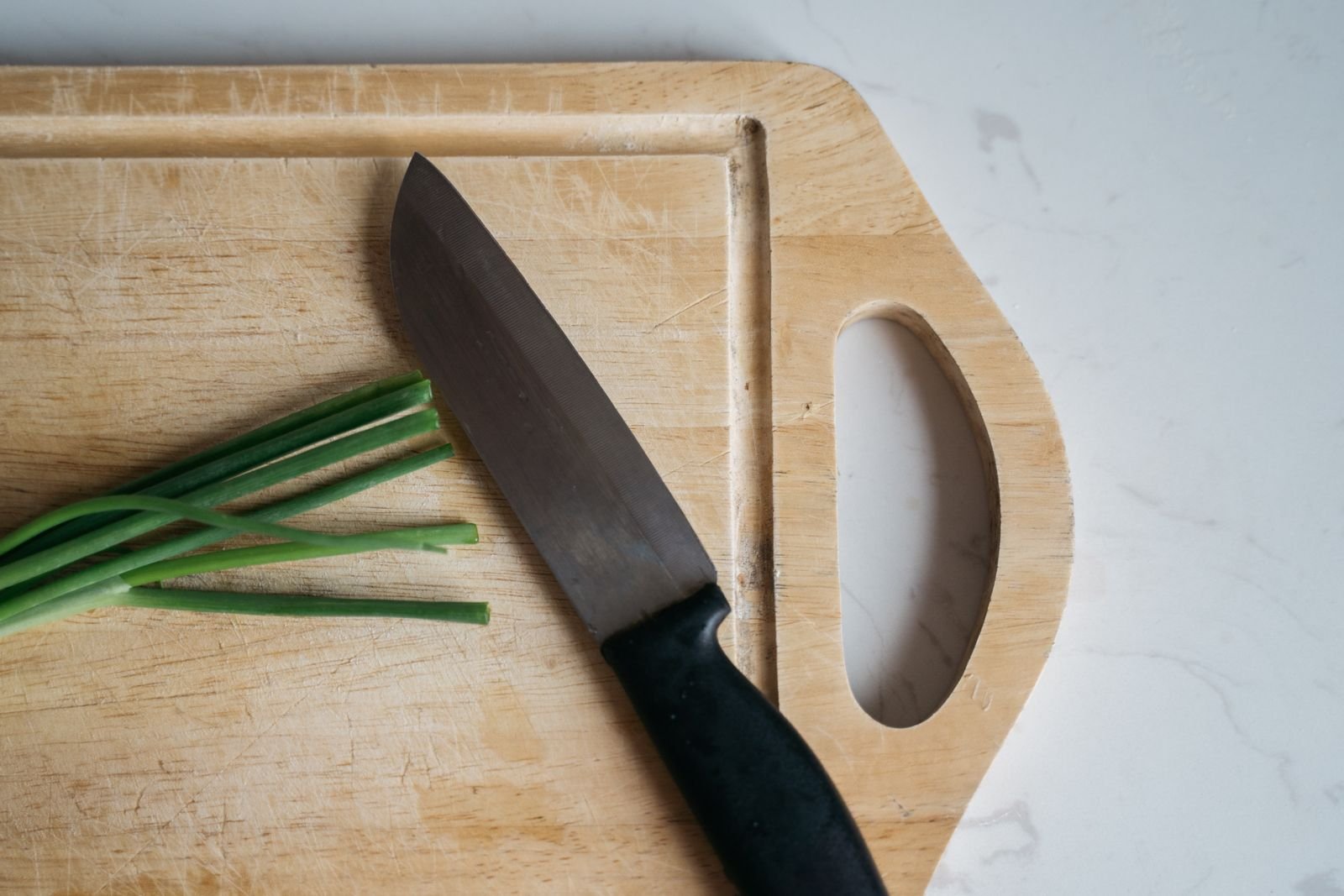
Set a timer for ten minutes. Put a cutting board on the counter, find your largest knife, and pull two carrots, a stalk of celery, and an onion from the crisper drawer. That is the whole setup. You are not making dinner yet. You are practicing, and the vegetables are going into a soup or stock later, so nothing is wasted.
We have watched a lot of home cooks work through our recipes, and the thing that slows people down most is rarely the cooking. It is the chopping. Ten focused minutes a few times a week does more for speed and comfort than any gadget. Here is how we would spend those minutes.
Minute one: make the board stay put
A board that slides is a board that eventually surprises you. Before anything else, dampen a paper towel or thin kitchen towel, wring it out, and lay it flat under the cutting board. A thin rubber mat works too. Press on each corner of the board. If it rocks or shifts, fix it before you pick up the knife.
While you are there, check your height. Your elbow should be comfortably bent, with the board somewhere around the level of your hip bones. If the counter is low, a thicker board raises the work surface. If it is high, try working at a lower table for practice sessions.
Minutes two and three: the grip
Many people hold a chef's knife by the handle with their index finger pointing down the spine. It feels secure, but it gives you surprisingly little control over the blade. Try the pinch grip instead:
- Hold the handle with your middle, ring, and little fingers.
- Pinch the flat of the blade, just in front of the handle, between your thumb and the side of your curled index finger.
- Keep your wrist straight, so the knife feels like an extension of your forearm.
It will feel odd for a week. Then it will feel normal, and the old grip will feel like steering a car with one finger.
Minutes four through six: the claw
The hand that is not holding the knife does half the work. It holds the food steady and sets the thickness of each slice, and it does that as a claw:
- Curl your fingertips under so the first knuckles face the blade.
- Let the flat side of the knife rest lightly against those knuckles.
- Tuck your thumb behind the food, away from the edge.
- Move the claw back a little after each cut, and let the knife follow.
Practice this slowly on a carrot. First, cut a thin strip off one side so it lies flat and cannot roll; a round vegetable on a flat board is an accident waiting for an opening. Then slice coins, watching your knuckles rather than the tip of the knife. Speed is not the goal today. Even slices are.
Minutes seven through ten: the rocking cut
A chef's knife has a curved belly for a reason. The rocking cut uses that curve so the tip barely leaves the board:
- Place the tip of the knife on the board, just beyond the food.
- Lower the heel of the blade through the food, pushing slightly forward as you go.
- Lift the heel back up while the tip stays down, shift back a hair, and repeat.
Try it on the celery, cut into long strips first and then across into small dice. Keep your claw in place and let the rhythm find you. If the knife is catching or crushing instead of slicing, it probably needs sharpening. A dull knife takes more pressure, and more pressure is exactly when blades slip.
The onion, for the last minute
Halve the onion through the root, peel it, and lay each half cut side down. Make vertical cuts toward the root without cutting through it, so the root holds the layers together. Then slice across. You will have a diced onion and, most likely, a small feeling of triumph.
A few rules we never skip
- Never try to catch a falling knife. Step back and let it land.
- Do not leave knives in a sink of soapy water, where nobody can see them.
- Scrape food across the board with the spine, not the edge. It keeps the edge sharp and your fingers out of the way.
- Wipe the blade and put it away when you are done, rather than leaving it at the edge of the counter.
When the timer goes off, stop, even if you are enjoying yourself. Short and frequent beats long and occasional, because your hands learn best when they are not tired. Scrape everything into a container for tomorrow's soup, refrigerate it, and wash up.
After a few weeks, you will notice that the prep list on a recipe card no longer looks like a mountain. That is the payoff. The recipes did not get shorter. You got quicker, and a good deal steadier too.